Afrasian Imaginaries
My current research argues that the Indian Ocean’s African and Asian communities with their millennia long history of trade and exchange have important contributions to make in our understanding of structures and effects of capitalism. To better understand the mechanizations of our neoliberal contemporary, we need a fuller history of what precedes this moment. Contemporary cultural workers harness this past in their meditations on current political, social, and economic crises and in so doing, they trouble the promises of the postcolonial state. In exposing the fault lines of this moment, which we can attribute to neocolonial imperatives, the literary and cultural archive I’ve constructed in Afrasian Imaginaries: Global Capitalism in Indian Ocean Worlds asks us to confront the ghosts of a deeper, more entangled past.
To put it another way, this project participates in a robust interdisciplinary endeavor that questions the distinction between freedom and enslavement, or independent and colonized. The organizational logic of the imperial archive partitioned connected histories; a process that U.S. empire further elaborated upon through the model of Area Studies, where intellectual energies were focused primarily around landed geographies, such as Africa, South Asia, or the Caribbean thus it minimized the possibility of studying the networks between such spaces not only in the contemporary moment or the post World War II period, but it worked backwards in time to impose that spatial configuration in earlier temporalities.
Afrasian Imaginaries focuses on twentieth and twenty-first century cultural texts from African and Asian Indian Ocean communities that offer counter narratives to the overwhelmingly Eurocentric ones available to us. Focusing on representations of historical and contemporary Afro-Asian multilateral movements across the Indian Ocean, I recast narratives of global capitalism that foreground systems of trade and exchange that refuse to assimilate easily into the prevailing notion that EuroAmerican modernity created capitalism and imposed it upon the formerly colonized world. Indian Ocean fictions and theoretical perspectives draw on the multi-layered histories of the ocean’s littoral communities to attune us to alternative disciplinary structures. In so doing, they offer resources for interrupting and subverting the disciplinary mechanisms of control, surveillance, and exploitation that characterize global capitalisms.
The book crafts broader relational analyses of global capitalisms, illustrating how an Indian Ocean archive of imaginative works uses histories of the region as a resource to re-articulate relationships across the ocean’s littoral. Circumventing center-periphery approaches to studies of the Global South, Afrasian Imaginaries develops a framework for understanding the intersections of postcolonial statecraft in south-south contexts, the circulation of ideologies of freedom, and the transfer of technologies of discipline and surveillance in labor zones across the Indian Ocean.
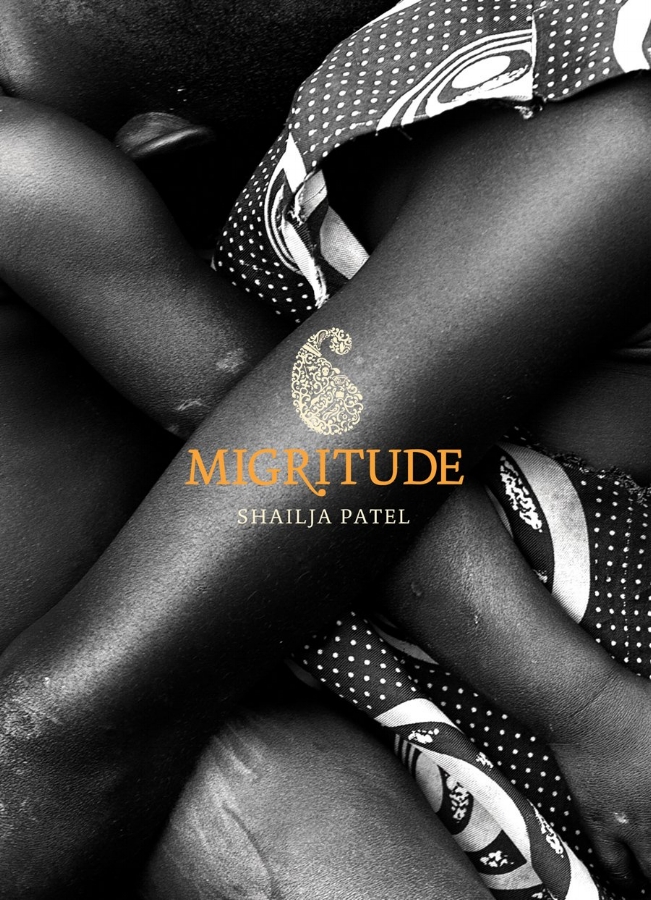
Migritude’s Decolonial Lessons
Published in a special issue on Indian Ocean’s Trajectories of the Journal of Eastern African Literary and Cultural Studies, Migritude’s Decolonial Lessons, traces the deep time of the Indian Ocean through and against which Shailja Patel fabulates the notion of migritude and, in particular, its valences for solidarities between black and brown Kenyans and other south-south relationships. Attentive to the multiple voices she invites into the text and the material objects that she imbues with those voices, I show how Patel animates histories otherwise obscured toward a larger political project of reckoning with Empire’s violences. The essay in three movements meditates on (1) the transmutation of Migritude across generic forms; (2) in the book text, the grafting of Patel’s familial history onto (macro) History, which ruptures the telos of modernity by exposing its violences; and (3) the consciousness raising that occurs as Patel accounts for the sexual violence British soldiers perpetrated upon Kenyan women and children from the colonial to the postcolonial period. Migritude’s decolonial lessons move trans-temporally toward the past to repair relationships between women in the Global South, and into our present and its conditional futures to imagine new solidarities and alliances in the heartlands of the dispossessed.
Capitalism’s Carceral Geographies
My second project traces the logics of incarceration across colonial, postcolonial, and neocolonial statecraft, particularly how disciplinary mechanisms of militarism and carcerality bind sites across Africa, Asia, and the Caribbean. Through a corpus of literary and cultural works made by incarcerated writers and artists as well as revolutionary organizations juxtaposed with legal and policy documents crafted by nation-states and transnational organizations, this work aims to reveal how the rhetorics of terrorism produce a set of global operations of security and carceral infrastructures that consolidate themselves in carceral state apparatuses from border walls to detention camps.
Preliminary research from this project has been shared with audiences at the American Studies Association and Historical Materialism: Athens. A course on Carcerality at Sea, which draws from the central concerns of this project will be taught at Georgia State University in AY2027-28.